The codice fiscale is the single most important administrative document you will acquire in Italy. It is algorithmically generated from your name, date of birth, and place of birth, and once issued incorrectly, it is very hard to undo.
The codice fiscale is the Italian tax identification number, and it is the single most important administrative document you will acquire in Italy. It is generated algorithmically from your full legal name, date of birth, and place of birth, and once it is issued incorrectly, it is very hard to undo.
It is also a prerequisite for almost anything you might want to do in Italy. The codice fiscale is required to sign a rental contract, open a bank account, register a utility, buy a SIM card, enroll in the national health service, register a vehicle, pay property taxes, receive a wire transfer into an Italian bank, sign an employment contract, buy or sell real estate, execute a notarized deed, establish a company or a partita IVA, invoice a client, enroll a child in school, register at a university, pick up a prescription, or register at the anagrafe for residency. Hotels ask for it at check-in above a certain threshold. Pharmacies ask for it for deductible receipts. Couriers ask for it at the door. For anything in Italy that produces a contract, a bill, or a document with a name on it, expect the codice fiscale to be required.
The good news is that you do not need an attorney or an accountant to obtain one. The process can be handled directly at the Agenzia delle Entrate in Italy, and in narrower circumstances at an Italian consulate abroad. The less good news is that the process has a number of procedural traps that are not written down anywhere obvious, and most people who try it without preparation get sent home to come back another day. The stakes are higher than people expect, because an incorrectly issued codice fiscale is extremely difficult to correct and can create years of administrative friction across all of the uses listed above.
Where You Can Get It
The Agenzia delle Entrate (AdE) is the primary issuer, and it is also the issuer least likely to make a mistake. Anything we say below about booking, documents, form filling, and name accuracy is written assuming you are going to an AdE office in Italy.
The two other paths that exist, an Italian consulate abroad and certain immigration offices or universities in Italy, are in general riskier.
Italian consulates historically issued codici fiscali to foreign nationals who needed one before moving to Italy. As of July 15, 2024, a directive from the Ministero degli Affari Esteri e della Cooperazione Internazionale (MAECI) sharply restricted this practice worldwide. Whether a given consulate will issue the code in a given case is hit or miss, and depends less on the city and more on the applicant's reason for needing it. Property matters (closing a purchase, managing an inherited home, paying property taxes), inheritance and succession, and cases where the code is needed for something the applicant is not traveling to Italy for are the requests most reliably approved. Visa-related requests where the applicant will be arriving in Italy anyway (student, work, elective residence, digital nomad) are now the cases consulates most often decline, with the instruction that the code can be issued at the local AdE office after arrival. Some consulates still process a mailed application when the applicant has a verifiable reason for not appearing in person, but the package must be complete on the first submission. Consulates often do not follow up to ask for missing pieces.
Certain immigration offices (Questure and some prefetture) and some Italian universities also have the authority to issue a codice fiscale, usually bundled into a larger process. At an immigration office, the code can be issued alongside a permesso di soggiorno or carta di soggiorno (the residency registration itself is handled separately, by the comune). At a university, the code can be issued as part of student enrollment once the student has already arrived in Italy; the study visa itself is handled earlier at the consulate and does not by itself produce a codice fiscale.
The codice fiscale is always generated by the same standard algorithm applied to the applicant's name, date of birth, and place of birth. The same inputs produce the same code regardless of who enters them. What these offices do is issue, and in practice letting them handle it almost always goes terribly.
The most common failure at immigration offices is that the office prints the permesso without completing the registration of the codice fiscale in the AdE system. The applicant walks out with a number that the officer generated from the algorithm, shows it to a bank or notary, and the lookup returns nothing because the code was never activated in the central database. Correcting this afterward means starting over. Data-entry error rates are also materially higher at non-AdE offices: transposed given and family names, day-month and month-day confusion, place-of-birth fields entered inconsistently with the passport. Because the code is algorithmically derived from those inputs, any of these errors produces a code that will never match the applicant's other documents.
Universities present the same problem in a slightly different form. A foreign-student office will often run the algorithm against the anagrafic data the student provided at enrollment and hand back a code that looks fine on a university form but has never been registered with the AdE. It works for on-campus purposes and fails the moment the student tries to use it at a bank, with a telecom carrier, or with the national health service.
Whenever possible, obtain the code at the AdE first. When you then arrive at your Questura appointment or your university enrollment with a code already in hand, they will record it rather than try to generate one, and the single highest-probability source of error in the whole foreign-applicant process is removed.
If you do end up at the Questura or a university, insist on a stamped paper attribution certificate before you leave the office. Not a number written on a form, not an email. Read it line by line at the desk: given names in full, both family names if you have two, day and month of birth, place of birth against your passport, and every character of the issued code. Officers will sometimes downplay small errors because they do not want to redo the paperwork. Do not accept that. An incorrect codice fiscale is essentially permanent.
Booking the Appointment at the Agenzia delle Entrate
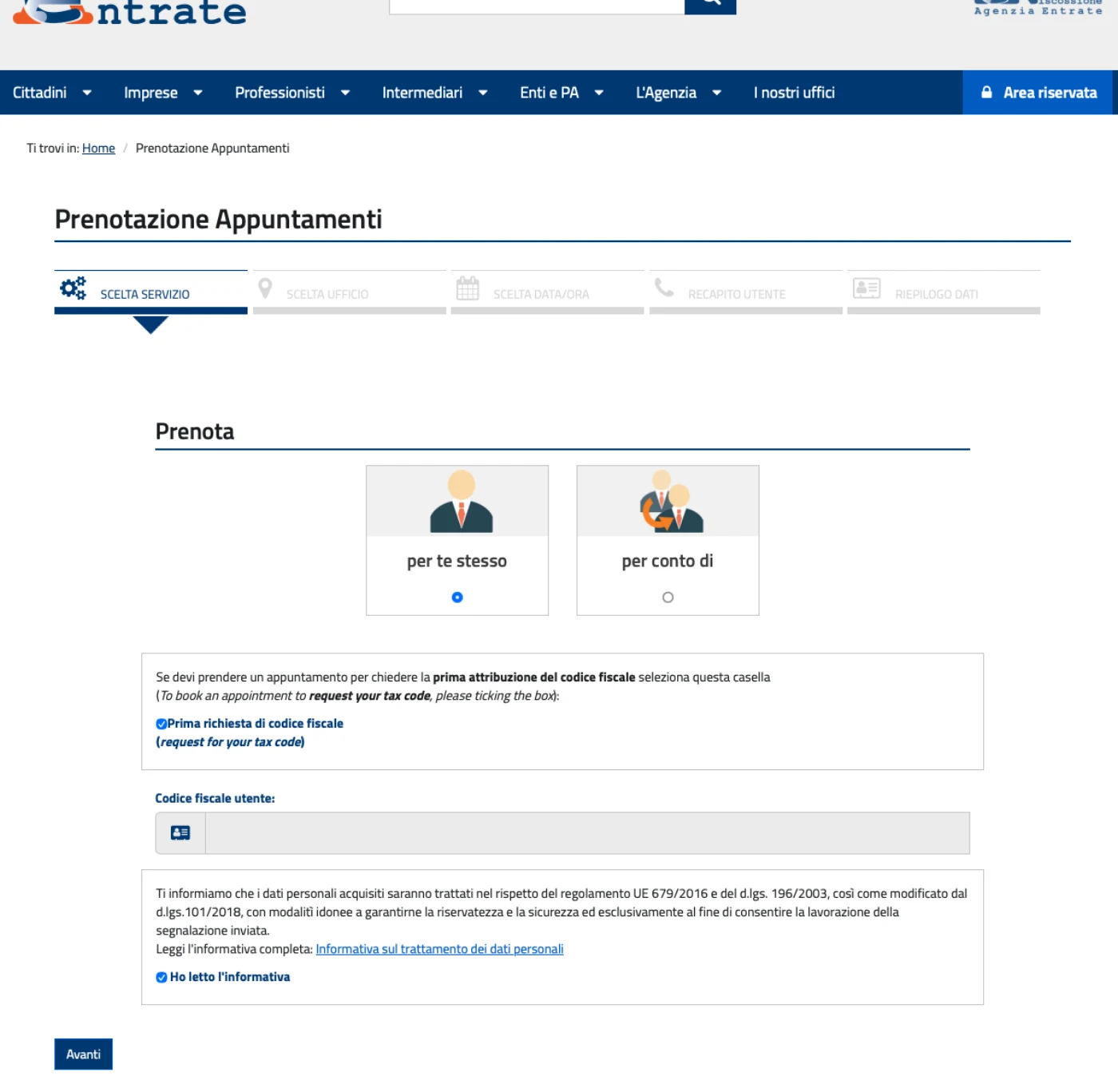
Most AdE offices require an appointment, booked through the "Prenotazione Appuntamenti" portal at agenziaentrate.gov.it. The booking screen asks for your codice fiscale. This is the circular problem that catches nearly every foreigner: you are trying to book an appointment specifically to get a codice fiscale, and the system is asking you to enter one.
The workaround is a specific checkbox directly under the "per te stesso" / "per conto di" choice, labeled "Prima richiesta di codice fiscale" in Italian with the English subtitle "request for your tax code." If you tick it, the booking engine accepts the request without a codice fiscale in the "Codice fiscale utente" field and lets you proceed. Also tick "Ho letto l'informativa" to acknowledge the privacy notice, then click "Avanti." The subsequent screens collect your passport details, name, date and place of birth, and a contact email or phone, and issue a confirmation with a reservation code.
Bring Everything in Duplicate, and in Triplicate if You Can
The single most common reason applicants are sent home on the day of their appointment is missing documentation. The AdE will not usually make copies for you. The office does not have a customer-facing photocopier, and the answer to "can you copy this for me" is usually no.
Bring two clean photocopies of every document you plan to present, and three if you can spare the paper, in colour if you can. Paperclip rather than stapling; stapled sets cannot be separated for the file without damaging the paper. Never hand your originals to the employee. Keep your passport, birth certificate, and marriage certificate in your hand or your bag, show them across the desk to verify, but do not place them in the file pile. Employees are notorious for sweeping originals into the file along with the copies.
At minimum bring, in duplicate: your passport, including pages showing any recent entry stamp into the Schengen area or Italy (under the new European Entry/Exit System, a physical stamp or electronic entry record matters more than it used to; if you do not have one, bring a Dichiarazione di Presenza to bridge the gap); your residence permit (permesso di soggiorno) or its receipt (cedolino), if applicable; your visa, if applicable; your marriage certificate, divorce decree, or any other document that evidences a legal name change, paired with your birth certificate if the birth certificate shows a different surname from your passport. If your documents are in a language other than Italian, a sworn translation is sometimes requested, but this is rare as long as your passport and birth certificate show the same name.
Not all passports are treated equally at the counter. An EU or EEA passport is the path of least resistance: the ID is accepted at face value under EU regulation 910/2014 (eIDAS). Non-EU passports pass through additional scrutiny tied to the anti-money-laundering framework (Decreto Legislativo 231/2007). The AdE publishes a list of countries for which it applies more stringent documentation requirements on codice fiscale issuance, searchable under "paesi a rischio" in the codice fiscale guidance section; the list tracks the FATF enhanced-due-diligence jurisdictions and Italy's own AML high-risk roster. U.S., U.K., Canadian, Australian, Japanese, and EU/EEA passports generally pass without friction. Passports from some Caribbean citizenship-by-investment jurisdictions, several Middle Eastern countries on the FATF list, and a rotating set of African countries are processed more slowly and more conservatively. Check the list before you go, bring more documentation than you think you need, and plan for a longer appointment.
Getting the Name and the Place of Birth Right
The codice fiscale is generated from your exact full legal name as it appears in your identity document, your exact date of birth, and your exact place of birth. If any of these is entered with the slightest deviation, the code changes, and once it is issued, the code is extremely difficult to correct.
Include every part of your name, both given names and family names. Italy does not use the concept of a middle name. Its system recognizes given names (nomi) and family names (cognomi). If your passport reads "John Michael Alexander Smith," all three of "John," "Michael," and "Alexander" belong in the given-name field. Family names need the same care. Many countries follow a two-surname convention (Spain, most of Latin America, Portugal and Brazil, the Philippines, parts of lusophone Africa), and both surnames must go into the cognome field. Italian AdE agents sometimes default to entering only one of the two, which produces a code that no Spanish or Portuguese bank or civil-registry document will match. Point to the passport and insist that both family names be entered exactly as shown.
Use identical spellings. If your name contains an accent, umlaut, or non-Latin character on your passport, bring that exact spelling and insist the officer enter it character-for-character. There are certain transliteration rules for diacritics not found in Italian.
The place-of-birth rule works differently for foreign-born applicants than most people expect. The algorithm encodes place of birth as a four-character code. For Italian-born applicants, this is the code of the comune, so the specific city is part of the algorithmic output. For foreign-born applicants, the algorithm uses only the country code (Z404 for the United States, Z112 for Germany, Z114 for the United Kingdom, and so on). The specific city does not change the codice fiscale itself, as long as the country is correct. What the city does affect is the anagrafic record stored under your code in the AdE database, which banks and notaries pull up when they look you up. That record should match your passport exactly.
The country table still contains codes for states that no longer exist: the Soviet Union (Z154), Yugoslavia (Z118), Czechoslovakia (Z119), East Germany (Z111). Internal AdE guidance is to use the country in force at the date of birth, which would code a person born in Sarajevo in 1988 as Z118. In practice this creates downstream validation failures, because many banks, notaries, and INPS systems expect the successor state. The simplest rule is to use whatever country is listed as your place of birth on your current passport. If the passport shows the historical country, use the historical country code; if it shows the successor state, use that. Matching your codice fiscale to your passport keeps your records consistent across every other institution that will later read them. One exception: if you were born in a territory that was Italian at the time of your birth (parts of Istria and Dalmazia before the postwar border changes), you are coded to the Italian comune, not to the foreign country that later absorbed it.
Italian-Born Citizens and the Birth-Name Rule
If you were born an Italian citizen, the AdE treats your codice fiscale as tied permanently to your birth name, regardless of any later legal name change through marriage or otherwise. A woman born Maria Rossi who later takes her husband's name and becomes Maria Bianchi still has a codice fiscale that encodes "Rossi." The system does not update automatically.
Women changing their name at marriage is considered relatively unusual in Italy, where the custom is to retain the birth name for life. Most offices are familiar with the custom in other countries and are flexible about it, as long as you can produce documentation, whether a marriage certificate, a naturalization decree, or a civil-court order.
For Italians born abroad, our recommendation is to not change your legal name at all, because the codice fiscale will remain on the birth name and any change creates a mismatch between Italian and non-Italian records. If you have already changed your name abroad, the cleanest fix is to have the foreign name-change document legally translated into Italian and to formally change your name in Italy through the comune to match the name you adopted abroad. Leaving the mismatch in place does not prevent you from functioning, but it creates persistent problems: property deeds that do not match bank records, utility invoices that cannot be electronically linked, insurance claims that bounce, and notary appointments that require a thirty-minute preamble every time.
If you have ended up with two codes, the AA4/8 form includes a field called "Quadro E - Altri codici fiscali attribuiti al contribuente" where you declare the second one so the office can merge the records and designate one as the correct primary code. Use it.
The Most Common Consequence: Foreign Tax Credit Denials
The single most common and financially damaging consequence of a mismatched name that we see in practice relates to the creditability of foreign taxes. Americans resident in Italy are taxed by Italy on their worldwide income, including U.S.-source income, and the mechanism that prevents double taxation is a foreign tax credit claimed on the Italian return for taxes paid in the United States. To claim the credit, the taxpayer must submit a copy of the U.S. tax return to the AdE.
When the name on the U.S. tax return differs from the name on the Italian codice fiscale, the agency routinely takes the position that the two documents relate to two different people. This happens even when the taxpayer has the full documentary chain to prove otherwise. The AdE opens an inquiry, the foreign tax credit is denied pending resolution, and interest and penalties begin to accrue on what the agency now treats as an unpaid Italian tax liability on the same U.S. income. Resolution often takes years, and the same mismatch triggers the same denial the next year, and the year after.
The counterparty is not a person who can reason about the evidence. It is a combination of indifference, automated computer-matching, and rigid internal rules built around anti-money-laundering and know-your-customer compliance. The administrative effort of a name change in Italy is small. The administrative cost of fighting the AdE for four years over a foreign tax credit that should have cleared automatically is substantial.
The Form: Modello AA4/8
The official form is Modello AA4/8, "Domanda di attribuzione codice fiscale, comunicazione variazione dati, richiesta tesserino/duplicato tessera sanitaria." The current editable revision is dated June 2025 and is downloadable from the AdE website. The form is published in six languages: Italian, English, French, German, Spanish, and Slovenian. The accompanying "Mini guida" for foreigners is published in seventeen languages. The English form is the cleanest option for U.S. and U.K. applicants.
In Quadro A, "Tipo di richiesta," box 1 is "Attribuzione del codice fiscale" (first-time issuance), box 2 is "Variazione dati" (updating existing data), and box 3 is "Duplicato tessera sanitaria / tesserino codice fiscale" (replacement card).
Directly to the right of box 1 is a separate checkbox for "Richiesta tesserino di codice fiscale" (English: "Request for a tax code card"). This is the most commonly missed part of the whole application. Requesting the card is not technically mandatory, and most Italians already have a tessera sanitaria (the national health service card, which doubles as a codice fiscale card) and therefore do not need the separate tesserino, so the checkbox is easy to overlook as foreign-applicant boilerplate. For a foreign applicant who is not yet enrolled in the national health service and does not yet have a CIE (the Italian electronic ID card), the green tesserino is the only portable proof of your codice fiscale you will have until you obtain a tessera sanitaria or a CIE. Tick the box.
What you walk out of the office with at the end of your appointment is not the green card. After the agent enters your data and the system generates the code, you receive a plain white paper attribution certificate, printed and stamped by the office. That stamped paper is enough to complete most urgent next steps (opening a bank account, signing a lease, being added to a utility) and is accepted everywhere a codice fiscale needs to be shown.
The green tesserino itself is produced centrally and mailed to the residential address you list on the form. It is not mailed to the consulate, even if you applied through a consulate, and it is not mailed to a professional representative who attended the office on your behalf. It typically arrives three to six weeks after the appointment, though longer waits are common, and Italian postal delivery of these cards to foreign addresses is unreliable. If you do not yet have an Italian address of your own, list the address of a trusted contact, a serviced apartment, or a relative in Italy, and have them forward the card once it arrives.
Quadro E, as discussed above, is where you list any previously issued codici fiscali you are aware of. If you are applying for the first time, leave it blank.
Delega and Procura Speciale: Getting the Code When You Cannot Be in Italy
A third party in Italy can obtain a codice fiscale on your behalf. The standard instrument for this is the delega, and the delega is not a separate document: it is built directly into the AA4/8 form, in the "Riservato a chi presenta la richiesta" (reserved for the person presenting the request) section at the bottom. The applicant signs the applicant's section, the delegate completes and signs the presenter's section, and the form itself serves as the delegation. What the delegate brings to the office is a single signed AA4/8, a copy of the applicant's valid ID, and the delegate's own ID.
The procura speciale is the more formal instrument, reserved for special cases. In practice the case that almost always calls for one is a chain of representation where the person closest to the applicant is not the one who will actually appear at the AdE office. The typical scenario is an applicant in the United States who sends a procura speciale (signed before a notary public and apostilled) to a family member in Italy, and that family member in turn uses the delega section of the AA4/8 to authorize a commercialista or an avvocato to attend the office. The delega on the form cannot be sub-delegated on its own; the person named must present the application personally. A procura speciale is broader and can authorize further delegation, which is what makes it the right tool for these cross-border chains.
What kind of passport the applicant holds materially changes the probability that a delega on the AA4/8 is accepted on its own. In practice the delega is normally accepted for low-risk passports (EU, UK, U.S., Canada, Australia, Japan, and similar). For passports on the higher-scrutiny list referenced earlier, it is rarely accepted, and the office will typically insist that the application be presented by a qualified intermediary acting under a procura. Even with a qualified intermediary, some offices will still require the physical presence of the applicant. There is no single consistent rule, and the outcome depends on the specific office on the day. As a rough regional pattern, offices in the south tend to be more flexible than offices in the north, particularly when the intermediary is known locally.
The 2024 consulate policy has created a real problem for clients who are not yet in Italy but need the codice fiscale to complete a step that precedes arrival: signing a rental contract at distance, opening an Italian bank account, reserving a property purchase, enrolling a child in school, or submitting a visa file that specifically asks for the code. This is the gap JSBC fills. We act on behalf of clients using the delega section of the AA4/8 or, for cross-border chains of representation, a procura speciale executed in the client's country of residence, depending on the situation. We present the AA4/8 at the competent AdE office and walk out the same day with the stamped paper attribution certificate, which we then send on to the client.
We handle codice fiscale applications in Italy on behalf of clients who cannot be present. We walk out of the Agenzia delle Entrate office the same day with the stamped paper attribution certificate and send it to the client. We also help clients whose existing codice fiscale has been issued incorrectly reconcile the records so that bank, notary, and utility systems recognize a single, correct code.
Frequently Asked Questions
Do I really need an attorney or an accountant to get a codice fiscale?
No. The process can be handled directly at the Agenzia delle Entrate in Italy, and in narrower circumstances at an Italian consulate abroad. The catch is that it has a number of procedural traps that are not written down anywhere obvious, so most people who try it without preparation get sent home to come back another day.
Where is the safest place to obtain the code?
The Agenzia delle Entrate (AdE) is the primary issuer and the one least likely to make a mistake. Immigration offices (Questure) and universities can also issue a codice fiscale, but they are riskier: the most common failure is a code that the officer generated but never actually registered in the AdE system, so it returns nothing when a bank or notary looks it up. Whenever possible, get the code at the AdE first.
How do I book an AdE appointment when the booking system asks for a codice fiscale I do not yet have?
Tick the "Prima richiesta di codice fiscale" checkbox, subtitled "request for your tax code," directly under the "per te stesso" / "per conto di" choice on the booking portal. That lets the booking engine accept your request without a codice fiscale in the "Codice fiscale utente" field. Also tick "Ho letto l'informativa" and click "Avanti" to proceed.
Why does getting my name entered exactly right matter so much?
The code is algorithmically generated from your exact full legal name, date of birth, and place of birth, so even the slightest deviation changes the code, and once issued it is extremely difficult to correct. Include every given name and every family name exactly as they appear on your passport; if you have two surnames, insist that both are entered, because AdE agents sometimes default to only one.
Can someone obtain the codice fiscale for me if I cannot travel to Italy?
Yes. A third party in Italy can present your application using the delega section built into the AA4/8 form, or, for a cross-border chain of representation, a procura speciale executed in your country of residence. JSBC presents the AA4/8 at the competent AdE office and walks out the same day with the stamped paper attribution certificate, which we then send on to you.
Need a Codice Fiscale Without Traveling to Italy?
JSBC presents your AA4/8 application at the competent Agenzia delle Entrate office and sends you the stamped attribution certificate the same day, whether for a property closing, a bank account, a rental, or a visa file.
Book a Free Consultation →The information in this article is provided for general informational purposes only and does not constitute financial, legal, tax, or accounting advice. Any opinions expressed are solely those of the author and do not necessarily reflect the views of JSBC. You should not act or refrain from acting on the basis of this content without first seeking the advice of a qualified professional regarding your particular circumstances.