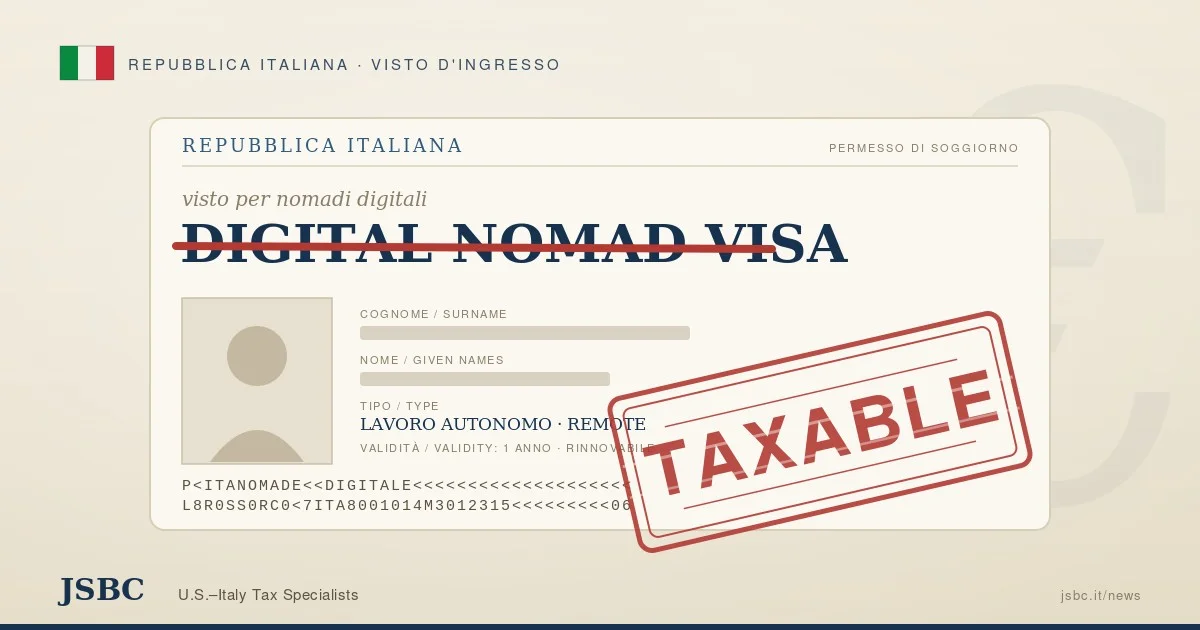
The word “nomad” implies you keep moving, and that no single country has a settled claim on you. Italy’s visa is the opposite on both counts. It requires you to commit to one registered Italian address, it makes you an Italian tax resident, and it then taxes the foreign income you earned to qualify for it. The name describes a tax outcome that does not exist. A more honest label would be the Foreign-Sourced Earned Income Visa, a more accurate and far less attractive name.
The Italian digital nomad visa makes you an Italian tax resident and then taxes the foreign income you earned to qualify for it.
– It requires a registered lease and a renewable permit, so it satisfies Italy's residence tests, and once resident your worldwide income is taxable in Italy at IRPEF rates up to 43%.
Your foreign salary is re-sourced to Italy because the work is performed there.
– Italian law taxes employment income where the keyboard sits, even when a foreign employer pays it into a non-Italian account.
Americans routinely pay the tax to the wrong country first.
– U.S. payroll keeps withholding as if nothing changed, but Italy holds the primary claim; you recover the over-withheld U.S. tax and pay Italy, and Form 673 stops the withholding at source.
The three decisions that protect you all happen before you arrive.
– Time the anagrafe registration near the year boundary, file Form 673, and secure the certificate of coverage before your first day of work.
What Is Italy’s Digital Nomad Visa, and Who Qualifies?
Italy created the category in early 2022, inserting it into the Consolidated Immigration Act, then left it dormant for two years.1 An interministerial decree finally set the operating rules in 2024 and split the category into two figures: the digital nomad, who is self-employed, and the remote worker, who is an employee or coordinated collaborator.2 The shared requirement is that the applicant be a non-EU national performing highly qualified work, the same standard used for the EU Blue Card.3
Read the actual application checklist and the nomad imagery collapses. You must produce a registered lease or a deed in your own name covering the entire duration of the visa, and a third party’s offer of hospitality or a hotel booking is expressly rejected. You must hold health insurance valid across Italy. Within eight working days of arrival you must present yourself at the local Questura to apply for a permesso di soggiorno, issued for one year and renewable only so long as you keep the same lodging, employment, and insurance.3 A permit conditioned on a fixed registered address and renewed at a single provincial police headquarters is not designed for someone who roams.
The income requirement is where the better name announces itself. You must demonstrate legal income of at least three times the annual amount that exempts a resident from healthcare co-payments, a floor of roughly 24,789 euros at the time the consulates published their guidance, with many posts applying a higher figure in practice.3 The decisive detail is the source rule attached to it: the income must derive from the work you will perform, and passive income such as Social Security, rents, or investment returns will not count.3 The visa is not granted to people with money. It is granted to people who earn, from foreign employers or foreign clients, by working. It is, in the most literal sense, a foreign-sourced earned income visa.
When Does the Digital Nomad Visa Make You an Italian Tax Resident?
The reason the name matters is that the same earned income the visa is built around is the income Italy taxes once you arrive, because the visa almost always makes you an Italian tax resident.
Since 1 January 2024 the test for individual residence has been rewritten.4 A person is resident if, for the greater part of the tax period counting even fractions of a day, any one of four alternative conditions is met: civil-law residence in Italy, domicile in Italy, physical presence in Italy, or enrolment in the resident population registry.4 Meeting any single test is enough. The greater part of the tax period means 183 days, 184 in a leap year, and those days need not be consecutive.4
Two features of the new rule are unforgiving for a visa holder. First, domicile has been redefined to mean the place where a person’s personal and family relations principally develop, a substantive test that privileges family and social ties over economic ones.4 Someone who relocates to Italy on a one-year permit, signs a lease, and brings a spouse or builds a settled life there has established domicile regardless of where the employer or the bank account sits. Second, the physical-presence limb now stands on its own, and the Agenzia delle Entrate has confirmed that a remote worker who is simply in Italy for 183 days becomes resident on that basis alone, after which all worldwide income is taxable in Italy.4 The guidance even counts a single hour inside Italian borders as a full day for this purpose.4
The registry presumption changed too, though in the taxpayer’s modest favor. Enrolment in the anagrafe used to be an irrebuttable presumption of residence. Under the 2023 reform it is a rebuttable one, so a person can in principle show that the formal registration does not match the factual situation.4 For a digital nomad this is cold comfort. The whole architecture of the visa, the fixed lease, the renewable permit, the long stay, tends to satisfy the other three criteria anyway, so there is usually nothing to rebut.
In our experience the registry matters more than the four-part test suggests, because in practice the Agenzia delle Entrate treats the anagrafe registration as the operative start of residence. It is, after all, the day you walked into the comune and asked to be made a resident, and it requires almost no further proof; the other tests tend to surface only when a taxpayer is arguing against that date. The mechanic that follows is the single most important date in the whole plan. Registering on or before the start of July generally makes you resident for the entire calendar year, while registering later pushes the clock to the following January.
Why Is Foreign Salary Taxed in Italy Once You Are Resident?
Clients find this part counterintuitive, because the salary feels foreign: a foreign employer pays it, often into a non-Italian account. None of that protects it.
Italian internal law sources employment income to the place where the work is physically performed, treating as produced in Italy any employment income for work carried out in Italian territory, even when a foreign party pays it.5 The Agenzia delle Entrate has been blunt about remote work in particular: a person performing employment activity in Italy is taxed in Italy on the income attributable to that activity, and this conclusion is not affected by the manner of performance, so work done remotely for a foreign employer is still considered performed in Italy, with Italian taxing power following.5 The same guidance confirms that the spread of smart working changed none of the residence tests.5
So the foreign salary is re-sourced to Italy because the keyboard is in Italy, and once you are resident the worldwide principle sweeps in everything else regardless. The “foreign-sourced earned income” that qualified you for the visa is taxed under ordinary IRPEF rates, which climb to 43 percent before regional and municipal surtaxes. Where the same income is also taxable abroad, relief runs through the foreign tax credit, but for an American the credit mechanics and the treaty’s saving clause mean the combined result requires modeling rather than assumption.
Which Italian Tax Regimes Can a Digital Nomad Actually Use?
The reformed impatriati regime exempts half of qualifying employment or self-employment income from IRPEF, or 60 percent if you relocate with a minor child, on income up to 600,000 euros a year, for the year of transfer plus the following four.6 A remote worker who keeps a foreign employer can use it. The Agenzia delle Entrate confirmed exactly that fact pattern in a 2026 ruling, and in a separate 2026 ruling held that continuity with the same foreign employer is not itself an obstacle provided the prior-foreign-residence threshold is met.6 But look at the conditions. The worker must be highly qualified, must not have been Italian-resident in the three tax years before the move, must perform the activity in Italy for the majority of the year, and must commit to remaining an Italian tax resident, with a clawback of the benefit if residence is not maintained for at least four years.6 If the work is for the same employer or group the person worked for abroad, the lookback stretches to six or seven years.6 A regime that demands a four-year residence commitment and majority-of-year presence is a regime for someone settling in Italy, not passing through.
There is a timing gotcha inside the regime that catches mid-year movers, and it is expensive. The relief reduces only income from work performed in Italy.6 Because residence is all or nothing for the year, the months you worked abroad earlier that year are pulled into your Italian return as worldwide income but fall outside the regime, since that work was not performed in Italy, so they are taxed in full at rates reaching 43 percent while only the post-arrival, Italy-performed income gets the reduction. A registration in June rather than near the year boundary can turn half of your annual earnings into fully taxed Italian income with no benefit at all.
The self-employed digital nomad has a second option, the flat-rate forfetario regime, which applies a substitute tax of 5 percent for the first five years and 15 percent thereafter, with simplified compliance, subject to its revenue ceiling and eligibility limits.7 It is attractive for a freelancer who qualifies, and it underscores the point. Italy did not write a bespoke tax regime for digital nomads. It folded them into the ordinary residence and income rules and left them to fit themselves into regimes built for permanent arrivals.7 The 7 percent pensioner regime, worth mentioning only to set it aside, is closed to this group because it requires foreign pension income, which the visa’s own rules exclude from the qualifying income test.
How Much Are Italian Social Contributions on a Digital Nomad Visa?
The default is that working from Italy pulls you into the Italian system. A self-employed digital nomad registers with the INPS Separate Management fund at roughly 26 percent of income, and an employee’s position is heavier still.7 What rescues many people is that, if you come from a country with the right agreement, you can sometimes keep contributing at home instead. Inside the EU the coordination rules and a cross-border telework agreement can hold contributions in the home country where telework stays below half of total working time.7 The visa is for non-EU nationals, so the practical question is whether your country has a bilateral social security agreement with Italy. Where one exists and you obtain a certificate of coverage, your home-country contributions continue and Italy stands down; where none applies, contributions fall due in Italy and the foreign employer may have to appoint an Italian social security representative to remit both the employer and employee shares.7
For an American this is the difference between two very different bills. The United States-Italy totalization agreement lets you stay in U.S. Social Security and Medicare, a combined 15.3 percent that, for a W-2 employee, is split with the employer and already withheld automatically through payroll, rather than paying Italian contributions that run far higher. The protection is not automatic in the legal sense. You claim it with the certificate of coverage, and you want that in hand before your first day of work.
Can Working From Italy Create a Permanent Establishment for Your Employer?
There is a final exposure that does not land on the worker at all, which is why it is so often missed. An employee working continuously from an Italian home for a foreign company can create a permanent establishment of that company in Italy, a risk the Agenzia delle Entrate flagged years ago and that the OECD addressed directly in a 2025 update.8 Under the refined criteria, a home office is unlikely to be a permanent establishment unless the remote work amounts to at least half of the person’s working time over a rolling twelve months and there is a genuine commercial reason for the presence rather than a purely personal one, with intermittent or auxiliary work not enough.8 A separate agency exposure arises if the worker habitually concludes contracts that bind the foreign employer from Italian soil.8
None of this threatens the visa, and in our view it is not where Italy is looking. The Agenzia delle Entrate appears to recognize that the situation is faintly absurd, since a single remote employee in a spare room reflects no intention by the foreign employer to establish a taxable presence in Italy, and permanent establishment enforcement does not seem to be pointed at digital nomads. We do not treat it as a substantive risk in the ordinary case. The exception is the nomad who both owns and manages the company that employs him. There the concern is no longer a stray home office but esterovestizione, the argument that a company directed from Italy is really tax-resident in Italy, and that is a real exposure worth structuring around before the move rather than assuming away.
This is where the visa contradicts itself. The clean fix for an employee actually working from Italy is for the employer to run compliant Italian payroll, normally through an employer of record, which puts withholding and contributions in the right place and contains the permanent establishment exposure. The visa specifically bars that route, because its premise is employment by a company based outside Italy, and shifting onto an Italian payroll provider undoes the condition the permit was granted on. In practice we file most digital nomads as self-employed for exactly this reason, even when the underlying arrangement is a salaried foreign job, because the visa leaves no clean way to localize the employment it insists you keep abroad.
Why Do Americans on This Visa End Up Paying Tax to the Wrong Country?
For a U.S. citizen the mechanics go wrong quietly, because nothing in the employer’s system changes on the day you land. The company keeps running U.S. payroll, federal and often state tax keeps being withheld, and the W-2 arrives in February looking entirely normal. None of it reflects where the income is now taxed. The work is performed in Italy and you are an Italian tax resident, so Italy holds the primary claim, and the United States taxes the same wages only because you carry its passport. The money is being withheld and remitted to the wrong treasury.
The damage surfaces at filing time, often through well-meaning help. An Italian commercialista sees that U.S. tax was paid and tries to claim an Italian foreign tax credit for it. That credit is not available, because Italy relieves foreign tax only on income produced abroad, and this income was produced in Italy.9 The correct sequence runs the other way. You file in the United States to claim the foreign earned income exclusion or the foreign tax credit, recover the over-withheld U.S. tax, and use those funds to pay the Italian tax owed to the Agenzia delle Entrate.9 The exclusion covers a large band of earned income, roughly 130,000 dollars in 2025, so for many digital nomads most of the U.S. liability should disappear once the return is filed correctly, which is exactly why parking that tax as a credit in Italy is the wrong move.
The real trap is timing. Recovering money from the United States means filing or amending a return inside its window, generally three years, and Italy’s own refund and amendment windows are finite as well. Someone who discovers the problem two or three years in, after several cycles of withholding to the wrong country and crediting it in the wrong country, can find that the cleanest route to recovery has partly closed. The income then risks being taxed in full by Italy with no practical way to claw the U.S. tax back, which is double taxation produced entirely by sequencing rather than by law. The cleanest fix is prospective. The employee files Form 673 with a U.S. employer so federal withholding stops at source, which avoids waiting on a refund the IRS, wary of fraud, is slow to release to Americans abroad. Failing that, file from year one on the footing that Italy is paid first and the United States relieves second.
What Do You Need to Renew an Italian Digital Nomad Visa?
The permit lasts one year, and to keep it you renew at the questura. This is where the nomad fiction finally breaks. Renewal turns on continued lodging, employment, and insurance, and many questure also want to see a filed Italian tax return before they extend the permit. The practice is not uniform, which is its own headache. The rules differ from one questura to the next, so a file that clears in a small southern comune can stall in the north, where the office insists on a particular sequence between the residency and the permit, and we have seen renewals waved through on a lease alone while others were held until a return was produced. The direction, though, is consistent. A permit that can require an Italian tax return to renew is a permit that requires you to have been resident, present, and taxable. That is the opposite of a nomad, and it is the clearest sign that the name is marketing while the substance is residence.
What Should You Do Before Moving to Italy on This Visa?
Three moves carry most of the value, and all of them have to happen before you arrive. Time the anagrafe registration deliberately, near the year boundary where you can, since it sets the residence start that drives both the tax year and the impatriati math. If you are American, file Form 673 so U.S. payroll withholding stops at source rather than stranding tax in the wrong country. And secure the certificate of coverage before your first day of work so your social security stays where it belongs. A pre-move tax assessment sequences all three against your own numbers.
The digital nomad visa requires foreign earned income to qualify, makes you an Italian tax resident, and then taxes that same income under ordinary Italian rules. The three decisions that protect you all happen before arrival: time the anagrafe registration near the year boundary, file Form 673 so U.S. withholding stops at source, and secure the certificate of coverage before your first day of work.
We map the residence, payroll, and social security position before you move, so the foreign-earned-income visa does not turn into a double-tax bill.
Book a Free Consultation →Frequently Asked Questions
Does Italy’s digital nomad visa make you an Italian tax resident?
In nearly every case, yes. Since 1 January 2024 a person is Italian tax-resident if, for the greater part of the year, they have residence, domicile, or mere physical presence in Italy, or are registered in the population registry. A visa that requires a registered lease and a renewable one-year permit, and that contemplates a long stay, will ordinarily satisfy at least one of those tests. Once resident, your worldwide income is taxable in Italy.
Is my foreign salary taxed in Italy if I work remotely from there?
Yes. Italian law treats employment income as produced in Italy when the work is physically performed in Italy, even if a foreign employer pays it. The Agenzia delle Entrate confirmed that remote work for a foreign employer is still considered performed in Italy and is therefore taxable in Italy. Where the income is also taxed abroad, you rely on the foreign tax credit and any applicable treaty to avoid double taxation.
Can a digital nomad use the impatriati regime to cut Italian tax?
Often, but with conditions. The regime exempts half of qualifying income from IRPEF for five years. You must be highly qualified, must not have been Italian-resident in the prior three years, must perform the work mostly in Italy, and must commit to staying resident for at least four years or face a clawback. If you keep the same foreign employer or group you had abroad, the prior-foreign-residence requirement extends to six or seven years. The exemption rises to 60 percent if you relocate with a minor child.
Do I have to file an Italian tax return to renew the visa?
Often, yes, though it depends on the questura. Renewal requires continued lodging, employment, and insurance, and many offices also ask to see a filed Italian tax return before extending the permit. Practice varies widely between questure, but the requirement is itself the point: a permit that can demand a tax return to renew assumes you have been resident and taxable in Italy, which is the opposite of a nomadic arrangement.
Do I owe Italian social security contributions as a digital nomad?
It depends on your status and your country. Working from Italy normally means Italian contributions, but if you come from a country with the right agreement you can sometimes keep paying at home instead, by obtaining a certificate of coverage. For a U.S. person that means staying in U.S. Social Security and Medicare, a combined 15.3 percent that W-2 employees already have withheld automatically, rather than the heavier Italian charge. If no agreement applies, contributions are due in Italy and the foreign employer may need an Italian social security representative.
Why call it a Foreign-Sourced Earned Income Visa?
Because that is what it is. The visa is granted only on proof of income earned from foreign work, with passive income excluded, and it makes you resident in Italy, where that earned income is taxed. The “nomad” label describes neither the residence obligations nor the tax outcome. The plainer name does both.
Sources
- Decreto-Legge 27 gennaio 2022, n. 4, art. 6-quinquies, convertito con modificazioni dalla Legge 28 marzo 2022, n. 25, introducing the digital nomad and remote worker category into the Testo Unico Immigrazione (D.Lgs. 286/1998).
- Decreto interministeriale 29 febbraio 2024 (Ministero dell’Interno, di concerto con il Ministero del Lavoro e degli Affari Esteri), implementing the visa and distinguishing the self-employed digital nomad from the employed or collaborating remote worker (D.Lgs. 81/2015).
- Consolato Generale d’Italia a New York, “Digital Nomad / Remote Worker VISA,” official requirements (registered lease for the full duration, health insurance of at least 30,000 euro, income of at least three times the healthcare-exemption threshold, roughly 24,789 euro, with passive income excluded, six months of prior experience, Article 27-quater D.Lgs. 286/1998 qualification, and a one-year renewable permesso di soggiorno): consnewyork.esteri.it
- Articolo 2, comma 2, TUIR as replaced by art. 1, D.Lgs. 27 dicembre 2023, n. 209, effective 1 January 2024, and Agenzia delle Entrate, Circolare n. 20/E del 4 novembre 2024 (four alternative residence criteria, the new domicile definition based on personal and family relations, the rebuttable registry presumption, and the 183-day count including fractions of a day): agenziaentrate.gov.it
- Agenzia delle Entrate, Circolare n. 25/E del 18 agosto 2023 (Article 23, comma 1, lett. c), TUIR sources employment income to where the work is performed, even if remunerated by a foreign party; remote work for a foreign employer is considered performed in Italy; smart working does not alter the Article 2 residence tests): agenziaentrate.gov.it
- Articolo 5, D.Lgs. 27 dicembre 2023, n. 209 (new impatriati regime: 50 percent exemption on income up to 600,000 euro, raised to 60 percent for a worker who relocates with a minor child or has one during the regime, three-year prior-foreign-residence requirement extended to six or seven years for the same employer or group, majority-of-year activity in Italy, high-qualification requirement, and the residence commitment with clawback). Agenzia delle Entrate, Risposta a interpello n. 2 del 12 gennaio 2026 (remote worker with a foreign employer may access the regime): agenziaentrate.gov.it; and Risposta a interpello n. 82 del 20 marzo 2026 (continuity with the same foreign employer is not an obstacle where the foreign-residence threshold is met).
- Regime forfetario, Legge 23 dicembre 2014, n. 190 (5 percent substitute tax for the first five years, then 15 percent, subject to eligibility limits); INPS Gestione Separata contribution rate of approximately 26 percent up to the annual ceiling (INPS Circolare n. 27/2025); Regolamento (CE) 883/2004 and the cross-border telework framework agreement in force since 1 January 2024 for EU situations; and bilateral social security agreements for non-EU nationals, with an Italian social security representative required for the foreign employer where contributions fall due in Italy. Summarized in Studio BCZ, “Italy’s Digital Nomad Visa: Legal, Tax and Social Security Framework” (25 March 2026): studiobcz.it
- Articolo 162 TUIR and Article 5 of the OECD Model Convention on permanent establishment; Agenzia delle Entrate, Circolare n. 33/E del 2020, § 7.5 (home-office permanent establishment risk for the non-resident employer); and the 2025 Update to the OECD Model Convention (approved 18 November 2025), under which a home office is generally not a permanent establishment unless remote work is at least 50 percent of working time over a rolling twelve months and there is a genuine commercial reason for the presence, with a separate agency permanent establishment risk where the worker habitually concludes contracts binding the foreign employer.
- Articolo 165 TUIR allows an Italian foreign tax credit only for taxes paid abroad on income produced abroad, so foreign withholding on employment income produced in Italy is not creditable in Italy. Under the United States-Italy income tax treaty, the saving clause (Article 1) preserves U.S. taxation of its citizens while the relief article (Article 23) requires the United States to relieve double taxation by crediting Italian tax, so relief on Italian-source employment income runs on the U.S. return, not the Italian one. Recovery of over-withheld U.S. tax is subject to the amended-return limitation period under IRC § 6511 (generally three years).
The information in this article is provided for general informational purposes only and does not constitute financial, legal, tax, or accounting advice. Any opinions expressed are solely those of the author and do not necessarily reflect the views of JSBC. You should not act or refrain from acting on the basis of this content without first seeking the advice of a qualified professional regarding your particular circumstances.