Tax residency is the single decision that governs almost everything else about a financial life that touches Italy. It decides whether Italy taxes your worldwide income or leaves your foreign pensions, investments, and gains alone. It decides which of Italy’s generous regimes you can reach, and in which year. It is the most expensive variable in any relocation, and, handled deliberately, the most controllable.
Most material on this subject recites the legal tests and stops. The tests are the easy part. The hard and valuable part is how the rules changed in 2024, what the Italian tax authority actually does in practice as opposed to what the statute says, how the date you walk into the comune interacts with a calendar that does not allow partial years, and what residency truly costs once it begins. This guide covers all of it, in the order you actually need to think about it. U.S. citizens carry a second system on their backs no matter where they live; that overlay is gathered into its own dedicated section near the end, so the main guide reads cleanly for everyone and Americans get a single, complete reference.
This is general information, not advice for your situation, and not legal or tax counsel. Cross-border outcomes turn on detail, and the difference between a good result and a bad one is usually a date or a document.
Resident or Not: What Is Actually at Stake
Italy taxes its residents on worldwide income and taxes non-residents only on Italian-source income.1 That is the whole hinge. A non-resident with a foreign pension, a foreign brokerage account, and a rental abroad owes Italy nothing on any of it. The same person, once resident, owes Italy on all of it, at rates that climb into the low-to-mid 40s percent, plus annual wealth taxes and reporting on foreign assets.
So the central question is never simply “how do I file.” It is whether and when to become resident at all, and how to time the switch so that income events, regime elections, and credits line up. Everything below serves that question.
What Changed in 2024
Italy rewrote its domestic residency test with effect from 2024, and the changes are substantive. You are an Italian tax resident for a calendar year if, for the majority of that year (at least 183 days, 184 in a leap year, counting fractions of a day as whole days), you meet any one of four criteria: registration in the resident population registry, domicile, habitual residence, or physical presence.2 Any single criterion is enough, and there is no legal ranking among them (the Agenzia delle Entrate residence rules set out the official tests).
Two of the four were redefined, and both cut against the casual mover.
Domicile now follows your family, not your money. Domicile used to lean on where your economic and business interests sat. After the reform it is the place where your personal and family relationships principally develop.3 If your spouse, your children, and the center of your personal life are in Italy, domicile points to Italy even if every account and every euro of income is managed from abroad. The old argument that “my business is still overseas” has lost most of its force.
Physical presence is now a standalone trigger. Simply being in Italy for the majority of the year now makes you resident on its own, regardless of why you are there, whether you registered, or where your home and family are.4 The day-count is literal and generous to the authority: a fraction of a day counts as a whole day, and the day you arrive, the day you leave, weekends, holidays, and sick days all count. This is the change that quietly catches students, remote workers, and people who spend “just a few months” in Italy each year.
The fourth criterion, registration in the resident population registry (the anagrafe), moved from a conclusive fact to a rebuttable presumption.5 You can now argue against it with evidence. The flip side, which clients consistently underestimate, is that not registering does not keep you out, because physical presence and family-domicile each stand on their own.
The Hierarchy of Tests: Three Different Orderings
People get the analysis wrong because they collapse three separate hierarchies into one. Keep them distinct.
1. The domestic criteria are alternative, with no legal ranking. Meet any one of the four for the majority of the year and you are resident under Italian law. That is the statute.
2. In enforcement, there is a clear practical order. The Agenzia delle Entrate almost always reaches for the anagrafe registration date first. When you register at a comune you file a formal declaration that you live in Italy, a self-created, undebatable record. Proving physical presence or center-of-life for a contested year is real work the authority generally has no appetite for when an easier answer sits in the registry. So on a first year the practical determination is usually the registration date. Physical presence comes second, and domicile (where your personal and family relationships mainly are) last, pursued only when the money clearly justifies the effort.
3. The treaty tie-breaker is a true sequence, and it only matters once two countries both claim you. When you are resident of both under domestic law, the applicable treaty assigns residence in strict order: permanent home, then center of vital interests, then habitual abode, then nationality.6 This is the hierarchy that governs dual residents.
Law Versus Practice: What the Agenzia delle Entrate Actually Does
This is the most useful thing to understand about the entire system, and it is almost never written down.
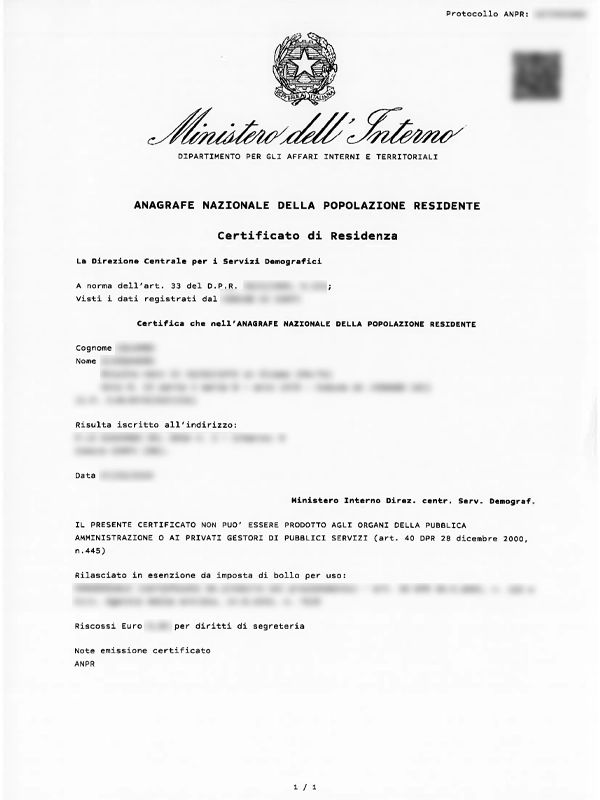
The single most authoritative piece of evidence in any residency file is not a day-count spreadsheet. It is the certificato di residenza, the comune document stating your official registration date. That date drives the residency start, the day-count, and every treaty position downstream. Pin it early, because reconstructing it from memory months later is unreliable and the government record wins regardless.
Two practical realities follow from the authority’s reliance on the registry. If you register, you have handed them the date, and on a first year they will generally use it rather than litigate the harder tests. That is why the registration date is the variable you manage above all others. If you never register, you generally do not receive the automated notices that follow registration, and presence-based enforcement against an unregistered person with no Italian income is currently rare. That is a statement about enforcement risk today, not about the law, and it is not a defense if your home and family are visibly in Italy. Where the facts point at Italy, a challenge would probably succeed, so “do nothing” has to be a documented position, with evidence that your home, work, and family are elsewhere, not an absence of one. Improving data-sharing makes presence-based enforcement easier every year, and we look at how the Agenzia delle Entrate actually monitors bank accounts and property in a dedicated piece.
Does 183 Days Make You Resident?
Residency requires meeting a criterion for the majority of the year, and Italy uses the solar (calendar) year: as a rule, it does not recognize partial-year residency. A year is all in or all out, so the date you cross the line splits the calendar cleanly:
- Establish a criterion on or before roughly July 1, and you are treated as resident for the entire year, retroactive to January 1.
- Cross the line after roughly July 2, and you fall short of 183 days. That year stays a non-resident year, and Italian residency begins the following January 1.
For most movers the play is to establish residency in the second half of the year, often August to October, which keeps the current year clean and shifts the start of Italian taxation, and the clock on any special regime, to the following January. That extra non-resident year is a full planning runway: time to realize gains, restructure holdings, complete a sale, and open Italian accounts and elections before Italy’s worldwide-income claim switches on. Do not register until you are actually ready, because once the date is set, the window closes. And remember that physical presence can trip residency on its own if you arrive before July and stay most of the year, even without registering; the usual fix is to spend enough of the back half of the year abroad and to document it.
The one real exception to the all-or-nothing year. A handful of Italy’s treaties contain a split-year clause that does allow residency to be divided mid-year, so each country taxes only its portion of the year. These are the exception, not the rule, and the list is short: Germany, Switzerland, and Panama.7 Where a split-year clause applies, a mid-year move can be cleanly halved. Where it does not, the calendar is all-or-nothing, and as the U.S. section notes, the treaty with the United States is not on that short list.
Does a Permesso di Soggiorno Make You Tax Resident?
A permesso di soggiorno is an immigration document: your legal right to stay. Anagraphical residence is a separate act, registration at the comune, and it is the usual evidence of, and one of four triggers for, tax residency. They run on different clocks, through different offices, and one does not automatically produce the other. Your immigration entry date and your tax-residency date are not the same thing, and the gap between them is where the planning lives.
This is the distinction clients miss most often, and it carries the most leverage.
Where you register changes how much control you have over the date. In large and northern comuni, the comune typically will not register your residence until your permesso has issued, which can take a year or two; Milan currently averages roughly two years for a newcomer’s first identity card, so the queue controls your date. In small southern comuni, residence is often registered in days, sometimes the same day, regardless of permesso status, which is an advantage when you want a specific date and a hazard if you register before you are ready. Routes such as ricongiungimento familiare (family reunification) and the permesso in attesa di cittadinanza (the permit while a citizenship application is pending) often let a comune, especially a small one, register residence and issue an identity card quickly, before a standard permesso would arrive.
Not every permit ties its renewal to tax residency, and that changes your options. Family-based permits (notably family reunification and the permit held as the family member of an Italian or EU citizen), student permits, religious permits, and status-of-forces (military) categories generally renew on their own grounds, family tie, enrollment, or status, without requiring an Italian tax return.8 The elective residency visa is the cautionary opposite: it effectively requires you to be tax resident, and it is both hard to renew and hard to change once chosen. If staying non-resident is your goal, the permit category you hold can make that either easy or nearly impossible, so choose it with the tax plan in mind, not separately.
The investor visa is the one we most often recommend for those who can fund it, because it buys the most flexibility. It does not require you to become tax resident at all: you make a qualifying Italian investment, the visa issues through a dedicated channel in roughly two months, you can come and go as you please, and you renew without establishing residency. It is also easily convertible to other categories, which the elective residency visa is not, and it permits work, which the elective residency visa does not. The qualifying thresholds are €250,000 in an innovative startup, €500,000 in an Italian company, €2 million in Italian government bonds, or a €1 million philanthropic donation.8 A European investor visa under one million euro is close to unique to Italy. There is one trade-off to plan around: the income produced by the qualifying investment is Italian-source, so it does not qualify for the 7% foreign-income regime, which means a retiree whose entire plan rests on the 7% may still prefer the elective residency route. For nearly everyone else, particularly non-retirees and anyone who may want to work, it is the most flexible way into Italy and the one we steer clients toward when the budget allows.
Do You Even Need to Be Resident?
Before timing anything, ask whether you need Italian tax residency at all, because for many people the honest answer is no. Residency is rarely beneficial on its own. It switches on worldwide taxation and foreign-asset reporting and gives little back, with one set of exceptions: Italy’s special regimes. Outside those, becoming resident usually adds cost and complexity and buys nothing.
So why do so many people become resident anyway? Usually because their permesso di soggiorno renewal requires it, as above. The immigration process pulls you into tax residency as a byproduct, not because residency itself served you. If your right to stay does not depend on a renewal that demands tax residency, for example you hold Italian or EU citizenship, or you hold one of the categories above, then registering as resident is usually something to avoid unless you specifically want a regime.
The Relocation-Agency Trap: Prima Casa and IMU
One specific, common trap deserves its own warning, because it is the way well-meaning people most often become resident by accident.
Many relocation agencies and attorneys often register a new arrival as resident at the comune immediately on a property purchase, to capture two genuine benefits. The first is the reduced purchase tax on a primary home, which requires the buyer to have or establish residence in the comune within eighteen months of purchase.9 The second is the exemption from the annual municipal property tax that applies to a primary residence, which requires your registered residence and your habitual home to coincide at the property (we explain Italy’s property taxes in full elsewhere).10 Both are real savings, and on their own merits worth having.
But the same registration that unlocks them is a self-declaration of residency, and it can do three kinds of damage. First, it can make you inadvertently tax resident for the entire year, because you asked to be, before you intended to and before you structured anything, and if it lands before the July line it captures the whole year retroactively. Second, if the immigration side then lags, as it routinely does, or your life does not actually settle at that address, you can fail the conditions later and face recovery of the purchase-tax saving with penalties and interest, while still carrying the tax residency you triggered.
Third, and most expensive, a rushed registration can cost you a regime you came for. If you intended to buy or rent a home in a qualifying southern town and claim the 7% pensioner flat tax, that regime must be established in your first year of Italian residency, in a qualifying community. An agency that registers your first Italian residency in a non-qualifying comune, a large northern city, say, or simply the wrong town, can forfeit the 7% entirely: your first resident year is spent in the wrong place, and by the time you reach the qualifying town you are already an Italian tax resident rather than a new one, and no longer eligible.11 A clerical convenience at the notaio can quietly destroy a decade of 7% taxation.
The benefits are real. The point is that no one should register you for them before you have decided when, and where, you actually want to become tax resident. The purchase-tax benefit, in particular, allows up to eighteen months to establish residence, so there is usually no reason to rush the registration into a year, or a town, you did not choose.
The Regimes: The Only Real Reason to Want Residency
Italy's incentive regimes are the reason most people want residency rather than fear it: the impatriate workers regime for people moving to work, the flat tax for new high-net-worth residents, the 7% regime for foreign pensioners who settle in a small southern town, and the forfettario for modest self-employment. Each has its own eligibility window, its own election, and its own interaction with the visa you apply for, so the regime has to be chosen at the planning stage rather than discovered after the move.
The rates, the qualifying conditions, and the way the regimes stack or exclude one another are the subject of our pillar guide to tax in Italy for foreigners. Read it alongside this one: that guide owns the numbers, this one owns the date you become subject to them.
Does Remote Work Make You Resident?
Working remotely from Italy for the majority of the year creates residency through the physical-presence criterion, even if your employer, clients, and pay are entirely outside Italy.14 The “digital nomad” framing gives false comfort. The authority treats sustained remote work from Italian soil as a residency event, and the permanent home you keep abroad becomes a tie-breaker argument rather than a shield. The digital nomad visa is the sharpest version of the trap, because the very foreign earned income you must document to qualify for it is exactly what Italy taxes once residency attaches; we walk through the mechanics in how the Italian digital nomad visa is taxed. If you intend to work from Italy across most of a year, plan for residency rather than hope to avoid it, and decide in advance whether a regime makes that residency worthwhile.
Students: What the 2024 Reform Quietly Changed
Students used to be the easy case. That changed in 2024, and it is the part of the reform most advisers have not adjusted to.
Before 2024, a foreign student living in Italy but not registered at the comune, with no Italian-source income and a life still centered at home, was comfortably non-resident, because physical presence by itself did not make you resident. The reform turned physical presence into a standalone trigger, so a student present in Italy for the majority of the academic year now fits the letter of the residency test on presence alone, with no registration, no domicile, and no intent to stay.15 No special carve-out for students was enacted, even though the reform’s own parent law had called for one.
In practice two things still protect most students, and both are conditional rather than automatic: a treaty tie-breaker (where one exists) that keeps a student whose home and center of life remain abroad assigned to the home country, and enforcement that still leans on the registration date rather than building presence cases against unregistered students with no Italian income. Handled correctly, student years usually do not establish tax residency, which preserves the prior-non-residency windows the valuable regimes require, so a graduate can still enter the 7% or impatriate regimes later. Two fact patterns break that: a spouse, partner, or child in Italy, which can pull residency in through family-domicile even on a student permit, and the transition year, when studies end and the student lingers, shifts to a work or job-seeker permit, registers, or takes Italian income. The year to scrutinize is always the one where the student stops being a student.
Do Dual Citizens Need to Register with AIRE?
Italian citizens living abroad are required to register with the registry of Italians resident abroad (AIRE). Failure carries penalties and, more importantly for tax, undercuts any later argument that you were genuinely non-resident, because an old domestic registration can be treated as evidence of residence from that date forward. Dual citizens with stale Italian registrations should not assume non-residence based on physical absence alone; the documentary record is the authority’s primary evidence and the burden to rebut sits with the taxpayer. The upside is freedom: because a citizen does not depend on a permesso renewal, a citizen has the widest latitude to defer registration and time the first tax year deliberately, and two citizen spouses can both declare residence abroad through AIRE. If you are still establishing citizenship, note that the rules narrowed in 2026; see our guide to Italian citizenship by descent under the new reform.
What Residency Actually Costs Once It Starts
Becoming resident is not a status, it is a set of obligations. Worldwide income becomes taxable at Italian rates, taxed on the individual rather than the household, and on top of income tax sit the annual wealth charges on foreign real estate and foreign financial assets and the annual foreign-asset reporting return.
The full cost list, bracket by bracket and charge by charge, is set out in our guide to tax in Italy for foreigners. Price it before you trigger residency, not after.
If You Are a U.S. Person: The Part That Changes Everything
Everything above applies to Americans too, but U.S. citizens and green-card holders carry an extra system that no move to Italy switches off. This section gathers the whole overlay in one place.
You never stop being a U.S. taxpayer. The United States taxes its citizens and lawful permanent residents on worldwide income regardless of where they live. There is no “non-resident” U.S. return for a citizen; the non-resident form is for non-citizens (the IRS explains the U.S. resident and nonresident classification). Moving to Italy does not change your U.S. filing obligation at all.
A consequence worth using: you always have a U.S. tax residence available. Because the U.S. taxes you by citizenship, you are never “stateless” for tax and never without a home country. When you are caught between the two countries, you can always anchor to U.S. tax residency. Under the U.S.-Italy tax treaty’s tie-breaker rules, an American who keeps a genuine permanent home and center of life in the United States can be assigned U.S. residence; and because nationality sits at the bottom of the tie-breaker chain as the final tilt, a U.S. citizen has a backstop that most nationalities do not. In practice this means a U.S. person between countries can often default to the U.S. side rather than being forced into Italian residence, which is a planning asset when the goal is to stay out of the Italian net for a while.
But the saving clause is why winning the tie-breaker does not free you. The treaty contains a saving clause that lets the United States keep taxing its own citizens as if much of the treaty did not apply.17 So even an American who clearly belongs to Italy under the tie-breaker still answers to the IRS on the same income, and an American who anchors to the U.S. side still owes U.S. tax regardless. The treaty becomes a coordination-and-credit mechanism, not an exit. Relief flows through the foreign tax credit and specific treaty articles, but imperfectly, because the two systems run on different tax years with different deadlines: a credit earned in one country may not line up in time with the liability in the other, producing a cash-flow double taxation that only unwinds later, and only if the positions were documented from the first year. The full sequence of overlapping obligations is laid out in our U.S.-Italy dual filing calendar. The common, flawed instinct, file a U.S. extension and just pay the Italian tax, frequently produces exactly the double-tax friction it is meant to avoid.
Specific income streams. Private pensions, government-service pensions, and social-security benefits are allocated by dedicated treaty articles, and U.S. Social Security received by an Italian resident is generally taxable in Italy; the United States also taxes it for a U.S.-only citizen and credits the Italian tax, while a dual U.S.-Italian citizen owes the United States nothing on it.17 U.S. retirement accounts are taxed by Italy on distribution, generally at ordinary marginal rates rather than as tax-favored income, and Italy does not recognize the tax-free status of Roth distributions, so Roth and traditional withdrawals and required minimum distributions can all be taxed at Italian marginal rates up to the low-to-mid 40s. The planning response is usually pre-move: Roth drawdowns while still U.S.-tax-free, or accelerated distributions taxed at U.S. rates in low-income years, or sheltering the whole stream under the 7% regime for those who qualify, a route the Agenzia delle Entrate has confirmed for SEPP/72(t) distributions.
Entities and trusts. A U.S. multi-member LLC creates a structural mismatch, because the U.S. taxes members on accrual-style income while Italy taxes on cash distributions as an opaque entity, two different amounts in two different years, which blocks a clean credit; the usual fix is to elect corporate treatment before establishing residency. Distributions from S-corporations and disregarded LLCs are generally taxed in Italy at 26% as foreign dividends regardless of what the entity earned, which is why Americans in Italy should not own an S-corp or disregarded LLC; running a U.S. company from Italy also risks reclassification as an Italian resident company. A typical U.S. revocable living trust where settlor and beneficiary are the same person is usually disregarded in Italy and taxed directly to the individual, with a credit for U.S. tax, while other structures map poorly onto Italy’s transparent-versus-opaque framework and can produce current taxation, 26% tax on gains inside the trust, and wealth-tax inclusion of the assets, a line the Agenzia delle Entrate drew in a 2026 ruling on U.S. trusts and IVAFE. The 7% regime conveniently collapses the trust distinction.
Social security contributions. Under the U.S.-Italy totalization agreement, a self-employed American can obtain a U.S. certificate of coverage, continue paying U.S. Social Security, and be exempt from Italian INPS contributions for the covered period, avoiding a double social-contribution layer that can otherwise reach into the teens of percent on the same income.17 It is one of the higher-value, lower-effort moves available.
Two recurring traps. Not every Italian substitute tax is creditable in the U.S.: the 26% flat tax is, and the 7% regime tax is on our reading, but a fixed lump sum such as the high-net-worth new-resident regime’s is far less certain. A regime that removes Italian tax also leaves nothing to credit, so U.S. tax on that income is due in full; each substitute tax must be vetted individually, which is why a regime choice is always a two-country calculation. And the formulation of your name on your Italian codice fiscale must match your U.S. documents, because a mismatch causes the IRS to treat the U.S. and Italian filers as different people and reject the very foreign tax credit that prevents double taxation; fix it when the codice fiscale is issued, not after documents accumulate.
The split-year point, for Americans specifically. As noted in the calendar section, Italy allows mid-year residency splitting only with a short list of treaty partners. The United States is not among them, so an American’s first and last years follow the all-or-nothing calendar, and the registration date decides the whole year.
Who should prepare the return. A U.S.-only year before Italian residency can stay with any competent CPA. The first year that involves Italian residency needs a genuine cross-border specialist; generalist U.S. preparers and Italian-only commercialisti both routinely make structural errors, misclassifying retirement accounts, missing entity and trust interactions, and mis-sourcing income, that are costly to unwind. First-year U.S. estimates should lean on the prior-year safe harbor rather than be over-engineered, because the final credit mix is not known until the Italian return is finalized, and a credit should not be locked while an Italian refund is still possible. Finally, do not attempt to reverse-engineer a split year by retroactively canceling an Italian registration; it tends to fail, triggers re-filing, and creates a high audit profile in both countries.
A Practical Playbook
Decide your first Italian tax year first, then back the move date into it. If a large taxable event is coming, sequence the move so the event lands in a non-resident year, which usually means establishing residency after the early-July line so Italian taxation starts the following January.
Match the immigration route to the date you want. A small southern comune, family reunification, or a citizenship-pending permit can deliver an early, controllable date; a northern permesso queue can do the deferring for you; and the permit category determines whether renewal will force tax residency on you. Plan the immigration path and the tax date together.
Do not let anyone register you for the primary-home purchase-tax discount or the municipal-tax exemption before you have chosen your first tax year. The benefits are real, but the registration that unlocks them is a residency declaration.
Use the clean runway before residency for the restructuring that is painful afterward: drawing down retirement accounts at home-country rates, aligning entity structures, realizing gains while still outside the Italian net, and repositioning portfolios toward assets that credit cleanly.
Build the evidence file at the time, not in hindsight: the certificato di residenza, day-counts, the location of home and family, and a consistent name across systems are the documents that decide residency-start, credits, and any tie-breaker argument.
Worked Scenarios
These composites illustrate how the pieces fit. They are simplified and not advice.
The retiree heading south. Keep the move into the second half of one year so that year stays clean, draw down retirement balances at home-country rates during the runway, confirm a qualifying comune’s population before leasing, and register before the early-July line of the intended first year so the 7% clock starts on schedule. Result: foreign income taxed at 7% for a decade instead of marginal rates. Our Glide Slope framework lays out the full multi-year sequence for retirees.
The remote worker. Resident through physical presence regardless of registration, so avoidance is off the table; the real questions are which regime applies and which visa preserves access to it, since an elective residency visa would foreclose the impatriate regime.
The family that bought a house. A couple let a relocation agency register them on purchase to capture the primary-home tax breaks, and discovered they had become tax resident for the whole year before their planning was done. The lesson: the eighteen-month window on the purchase-tax benefit meant there was never a need to register that early.
The student. A degree in Italy, kept clean, does not establish residency and preserves later access to the regimes; the risks are a partner or child in Italy and the year studies end.
The dual citizen. Maximum flexibility, because no permesso renewal forces residency, but the first step is clearing any stale Italian registration the authority could treat as evidence of residence.
Common Mistakes
Registering at the comune before the structuring is done, and losing the clean year. Letting a relocation agency or attorney register you for the primary-home tax breaks without deciding your first tax year. Assuming a student visa, or any permesso, settles tax residency. Treating “not registering” as a strategy when home and family are plainly in Italy. Picking a visa that forecloses the regime you wanted, or one that forces tax residency at renewal. Choosing a regime without checking home-country creditability. Carrying a multi-member LLC or an S-corporation into residency. Letting a generalist prepare the first dual year. Reverse-engineering a split year after the fact. And the quiet one for Americans, a codice fiscale name that does not match U.S. documents, which blocks the foreign tax credit itself.
Frequently Asked Questions
If I keep my days under 183, am I safe?
Not necessarily. Physical presence is only one of four criteria. Family-domicile or comune registration can make you resident regardless of days, and the day-count counts partial days and travel days.
Can I split my first or last year between two countries?
As a rule Italy does not do partial years. A short list of treaties, Germany, Switzerland, and Panama, contains a split-year clause that allows it; most treaties, including the one with the United States, do not, so a genuine mid-year move sets which whole year is your first resident year rather than halving a year.
A relocation agency wants to register me as resident so I get the house-purchase tax break. Should I?
Be careful. The purchase-tax benefit allows up to eighteen months to establish residence, so there is rarely a need to register immediately, and registering is a residency declaration that can make you tax resident for the whole year before you intended.
Does my visa or permesso decide my tax residency?
No. Immigration status and tax status are separate. But the permit category matters indirectly, because some renew without tax residency and others, like the elective residency visa, effectively require it.
I am a U.S. citizen. Can I just stay U.S.-resident?
Often, yes, between countries you can anchor to U.S. tax residency, because the U.S. always taxes you and nationality is the final tie-breaker. But the saving clause means you owe U.S. tax either way, and once you genuinely settle in Italy the Italian claim attaches; the goal is to control the timing, not to avoid one system entirely.
Conclusion
Italian tax residency is not grey because the rules are vague. After 2024 they are fairly precise. It is grey because of the gap between what the statute says and what the Agenzia delle Entrate does on a first year, and, for Americans, because a second tax system never switches off. The registration date is knowable, movable, and usually decisive in practice; the regimes are generous but conditioned on that same date; and the cost of getting it wrong, a year of worldwide taxation you did not need, a regime missed by a week, a tax break that quietly made you resident, is almost always larger than the cost of planning it properly. Choose the date on purpose, structure during the clean runway, and the most expensive variable in your move becomes the one you control.
We map your residency timing, regime options, immigration route, and, for U.S. persons, the two-country calendar before any of it becomes an expensive surprise. To model the numbers yourself, start with our cross-border tax calculator.
Book a Free Consultation →Notes & Sources
- Italy taxes residents on worldwide income and non-residents on Italian-source income only; art. 3 of the Testo Unico delle Imposte sui Redditi (TUIR). ↩
- New art. 2, comma 2 TUIR as amended by Decreto Legislativo 27 dicembre 2023, n. 209, effective from fiscal year 2024; Agenzia delle Entrate, Circolare n. 20/E del 4 novembre 2024. The majority-of-period test counts fractions of a day as whole days. ↩
- Redefinition of domicile around the development of personal and family relationships, in priority to economic interests; D.Lgs. 209/2023 and Circolare n. 20/E del 2024. ↩
- Physical presence as an autonomous connecting criterion; Circolare n. 20/E del 2024. Consistent with international practice (OECD Commentary to art. 15 of the Model Convention; national practice C.M. n. 201/E del 1996), the count of days of presence includes fractions of a day, the day of arrival, the day of departure, weekends, holidays, and leave. ↩
- Registration in the resident population registry as a rebuttable presumption of residence; Circolare n. 20/E del 2024. ↩
- Residence and tie-breaker rules under Article 4 of the applicable bilateral double-taxation convention; for the United States, the Convention between the United States of America and the Italian Republic; see also IRS Publication 516 on application of treaty tie-breaker rules to dual residents. ↩
- Italy does not generally recognize partial-year tax residency; a split-year clause exists in only a limited number of Italy’s treaties, notably those with Germany, Switzerland, and Panama. On the Switzerland and Germany clauses, see Agenzia delle Entrate, Risposte a interpello n. 54/2023 and n. 73/2023. The Italy-Panama Convention provides for it expressly at Article 4: where a person is resident of one State for part of the year and of the other for the remaining part (change of residence), residence-based tax liability ceases in the first State at the end of the day of the change of domicile and begins in the other State the following day. The convention with the United States contains no such clause, and treaties without one (for example Italy-France) do not permit mid-year apportionment. ↩
- Permit renewal turns on the conditions of each permit category, not on tax residency: family-based permits, study permits, religious permits, and status-of-forces (military) categories generally renew on their own grounds, while income-based permits, notably the elective residency visa, effectively require demonstrated means and tax residency. The investor visa does not require tax residency to obtain or renew and is freely convertible; qualifying thresholds are €250,000 (innovative startup), €500,000 (Italian company), €2 million (government bonds), or €1 million (philanthropic donation). Framework: Testo Unico Immigrazione, D.Lgs. 286/1998 and the investor-visa provisions (art. 26-bis); minimum-means thresholds for income-based permits are tied to the social allowance (assegno sociale). ↩
- Reduced registration tax on the purchase of a primary home (“prima casa”): the buyer must have, or establish within eighteen months of purchase, residence in the comune where the property is located; failure to transfer residence within that period causes forfeiture of the benefit, with recovery of the tax difference plus penalties and interest. Art. 1, nota II-bis, Tariffa parte prima, D.P.R. 131/1986 (TUR); Agenzia delle Entrate, Risoluzione n. 53/2017 and Risposta a interpello n. 238/2024. ↩
- Exemption from the municipal property tax (IMU) for a primary residence (“abitazione principale”) requires the coincidence of registered (anagrafe) residence and habitual dwelling at the property. Art. 1, commi 740-741, L. 160/2019. ↩
- The 7% regime for foreign pensioners (art. 24-ter TUIR, introduced by Law n. 145/2018) requires no Italian tax residency in the prior five years and residence in a qualifying municipality in one of eight southern regions or designated earthquake-reconstruction zones; the eligible-municipality population threshold was raised from 20,000 to 30,000 residents by Law n. 34 of 11 March 2026, art. 26. The flat 7% applies to all foreign-source income for up to ten years and must be elected for the first year of Italian residency. ↩
- New impatriate workers regime: art. 5, D.Lgs. 209/2023, for residence transfers from 2024; 50% exemption of qualifying Italian employment and self-employment income (higher where a minor child is present) up to a statutory cap, for five years, conditioned on prior non-residence (generally three tax years, longer for same-employer-group moves), a qualification standard, and a minimum subsequent-residency commitment with clawback. The reduction reaches only income produced in Italy, that is, from work physically performed on Italian territory; income from work performed abroad is ineligible even in a year of Italian residency, since employment and self-employment income is sourced where the activity is carried out. The prior regime continues to apply to transfers made through 2023. ↩
- Regime for new residents (neo-domiciliati), art. 24-bis TUIR, for individuals not resident for nine of the prior ten years; available for up to fifteen years. The annual substitute tax on foreign income, originally €100,000, was raised to €200,000 (DL 113/2024) and most recently to €300,000 for transfers of residence from 1 January 2026 (art. 1 co. 25-26, L. 199/2025), with €50,000 per qualifying family member. Taxpayers already in the regime keep the rate in force when they first exercised the option. ↩
- On remote (“smart”) working from Italy as a residency event, see Agenzia delle Entrate, Circolare n. 25/E del 2023; residence is determined under art. 2, comma 2 TUIR regardless of the employer’s location. ↩
- Physical presence as a standalone trigger under the 2024 reform can treat a foreign student present in Italy for the greater part of the tax period as resident on presence alone, with treaty protection (where a treaty exists) as the backstop. The reform’s parent delegation law (L. 111/2023, art. 9) contemplated measures to favor students trained in Italy remaining; no such student-specific provision was enacted in D.Lgs. 209/2023. ↩
- Foreign-asset disclosure (monitoraggio fiscale, quadro RW; art. 4, D.L. 167/1990) and the wealth taxes on foreign real estate (IVIE) and foreign financial assets (IVAFE; art. 19, D.L. 201/2011) apply to Italian-resident individuals. Many categories of financial income are subject to an Italian substitute tax, commonly 26%. ↩
- The United States taxes citizens and lawful permanent residents on worldwide income regardless of residence; the U.S.-Italy income tax treaty’s saving clause preserves U.S. taxation of its citizens notwithstanding most treaty provisions, while the treaty tie-breaker (Article 4) and nationality as its final criterion allow a U.S. citizen to anchor to U.S. residence between countries. Pensions and government-service remuneration are allocated under Articles 18 and 19; U.S. social security paid to Italian residents is addressed in IRS Publication 915. Social-security contributions are coordinated under the U.S.-Italy Totalization Agreement; a U.S. certificate of coverage (filed with the Social Security Administration, Form SSA-2994-U3) keeps a covered worker in the U.S. system and exempt from Italian INPS for the covered period. See IRS Publications 54, 514, 516, and 915. Not every Italian substitute tax is creditable for U.S. foreign-tax-credit purposes: the 26% flat tax is, and the 7% regime tax is on our reading, but a fixed lump sum such as the high-net-worth new-resident regime’s is far less certain; a regime that removes Italian tax leaves nothing to credit, so U.S. tax on that income is due in full. Each substitute tax must be analyzed individually. ↩
The information in this article is provided for general informational purposes only and does not constitute financial, legal, tax, or accounting advice. Any opinions expressed are solely those of the author and do not necessarily reflect the views of JSBC. You should not act or refrain from acting on the basis of this content without first seeking the advice of a qualified professional regarding your particular circumstances.